
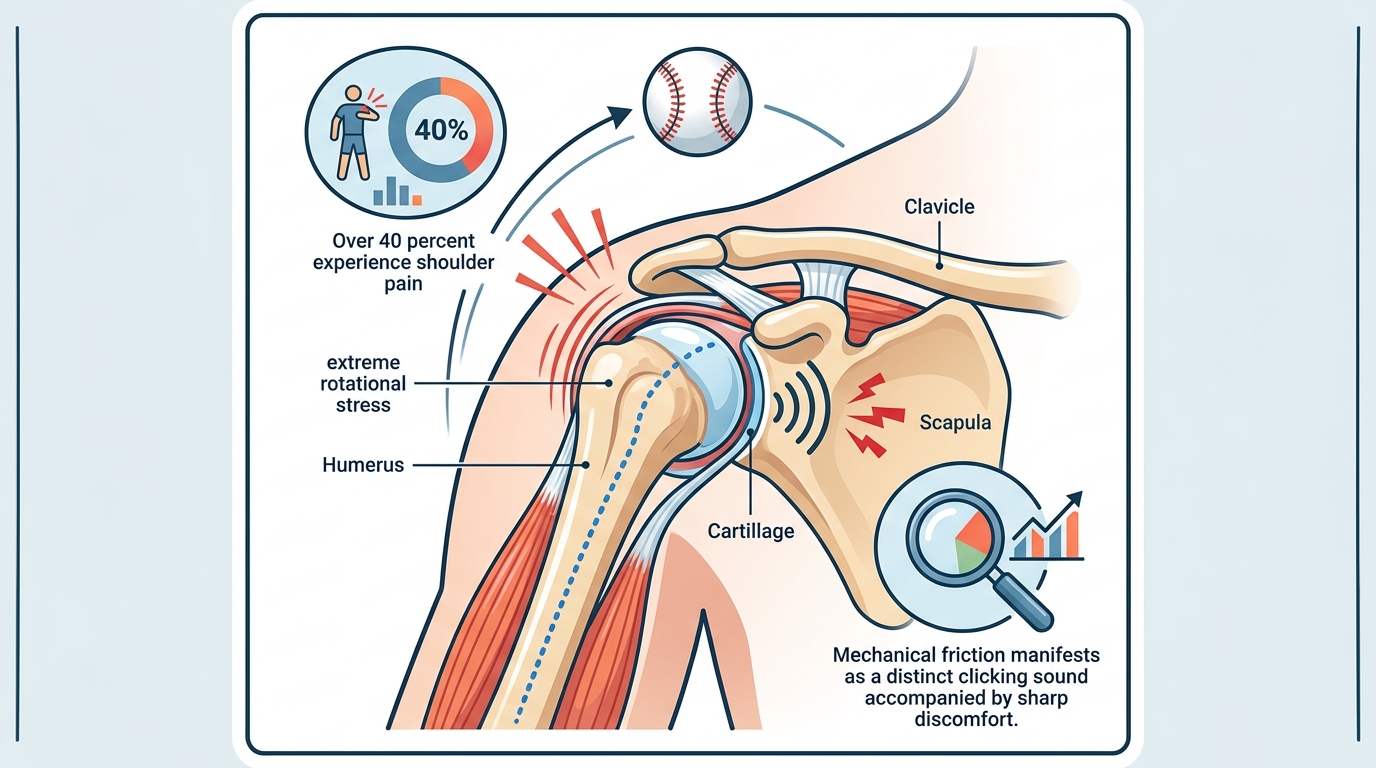
Throwing a ball places extreme rotational stress on the glenohumeral joint. According to the American Academy, over 40 percent of overhead athletes experience shoulder pain that directly impacts their performance. This mechanical friction often manifests as a distinct clicking sound accompanied by sharp discomfort. The noise typically signals a structural shift within the joint capsule. Athletes frequently ignore these early warnings until mobility declines. Recognizing the root cause of this mechanical noise allows for targeted intervention. Early evaluation prevents minor friction from progressing into chronic tissue damage. (About Us Lubbock Sports)
Understanding the Mechanics of Shoulder Clicking
The shoulder functions as the most mobile joint in the human body. This freedom of movement requires a delicate balance between bone structure and soft tissue. Shoulder impingement is a mechanical compression of the rotator cuff tendons beneath the acromion bone. When you throw, the humeral head rotates rapidly. This motion can cause inflamed tendons to rub against the acromion process. The resulting friction generates an audible click or pop. Repeated throwing amplifies this friction. The tissue swells and narrows the available space. This creates a cycle of inflammation and restricted motion. Athletes often report a grinding sensation during the deceleration phase. Addressing this friction early stops the progression of joint wear. (Charity Purser MSN FNP)
Biomechanical Stress Factors
Overhead throwing demands precise coordination across multiple muscle groups. Kinetic chain is the sequential muscle activation pattern that transfers force from the lower body to the throwing arm. A breakdown in this sequence shifts excessive load to the shoulder. Poor hip rotation or late trunk rotation forces the arm to compensate. The shoulder joint absorbs forces that exceed normal physiological limits. This overload accelerates cartilage wear and soft tissue strain. Tracking your throwing mechanics helps identify these compensatory patterns. Corrective drills restore proper force distribution.
Common Causes of Painful Shoulder Clicking
Multiple structural factors contribute to painful clicking during throwing. Labral tear is a structural separation of the fibrocartilage ring that stabilizes the glenohumeral joint. When this ring tears, loose fragments catch between the ball and socket. This catching mechanism produces a loud click or catch sensation. Athletes frequently describe this as a locking sensation during the cocking phase. Another frequent culprit involves bony spurs or calcified deposits. These deposits form after years of repetitive microtrauma. They physically obstruct smooth joint movement. Bursitis also contributes to the clicking noise. Inflamed fluid sacs swell and restrict normal gliding. The combination of structural damage and inflammation creates a painful feedback loop. Identifying the exact source requires targeted imaging and physical assessment.
Impact on Throwing Performance
Clicking rarely occurs in isolation. The accompanying pain directly reduces throwing velocity. Athletes subconsciously alter their mechanics to avoid the painful arc. This compensation creates secondary injuries in the elbow or lower back. According to the Mayo Clinic, untreated shoulder instability increases the risk of recurrent joint displacement by nearly 30 percent. The cumulative effect of altered mechanics accelerates career decline. Restoring pain-free range of motion remains the primary clinical objective. Targeted rehabilitation protocols address both the noise and the underlying instability.
Diagnostic Steps for Throwing Athletes
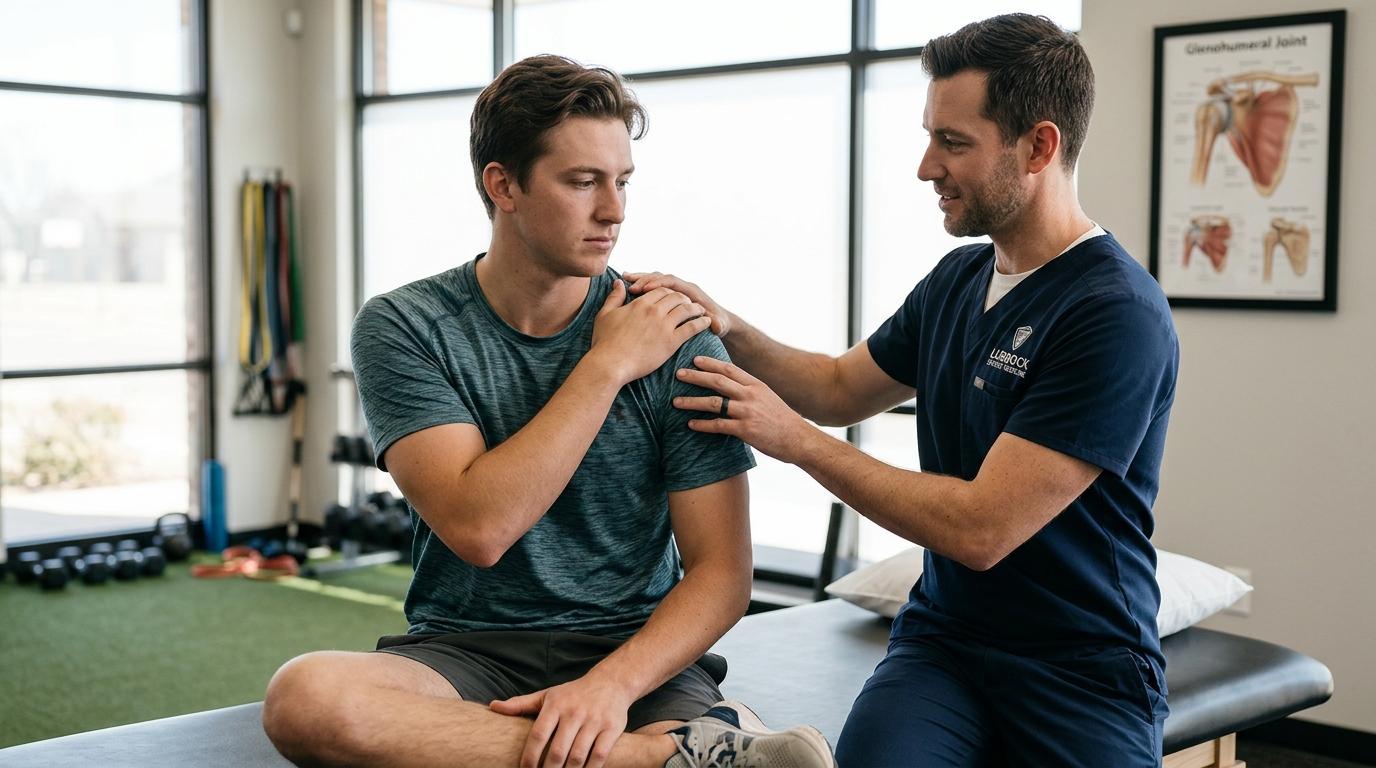
Accurate diagnosis requires a systematic clinical evaluation. Physicians begin with a detailed history of your throwing habits. They assess your specific position, pitch count, and recent workload changes. Physical examination tests isolate the painful arc of motion. Specialized orthopedic tests reproduce the clicking sensation. Imaging studies confirm the structural diagnosis. Magnetic resonance imaging provides detailed views of soft tissue damage. Ultrasound imaging captures dynamic joint movement in real time. These diagnostic tools guide precise treatment planning. Our clinical team at Lubbock Sports Medicine utilizes advanced diagnostic protocols to map your specific injury pattern. Early imaging prevents unnecessary delays in recovery. Accurate diagnosis ensures you receive the correct intervention strategy.
Advanced Imaging Protocols
Standard X-rays rule out fractures and severe arthritis. They do not visualize soft tissue damage effectively. Advanced imaging reveals subtle labral fraying or partial rotator cuff tears. Dynamic ultrasound captures the exact moment of joint clicking. This real-time visualization helps surgeons plan precise interventions. Our physicians at our clinical practice prioritize conservative imaging first. We reserve surgical planning for cases that fail structured rehabilitation. This stepwise approach maximizes long-term joint health.
Treatment Pathways and Recovery Timelines
Conservative management serves as the first line of defense. Rest eliminates the mechanical friction that triggers inflammation. Targeted physical therapy restores proper scapular positioning. Strengthening exercises rebuild the rotator cuff and periscapular muscles. According to the National Center, structured rehabilitation programs successfully resolve 75 percent of throwing-related shoulder complaints without surgery. Patients typically return to full throwing activities within 12 weeks. Progression follows a strict timeline. Early phases focus on pain reduction and mobility. Middle phases introduce light resistance and proprioceptive drills. Advanced phases simulate game-speed throwing mechanics. Our Lubbock Sports Rehab facility provides specialized equipment for this exact progression. We monitor your workload to prevent premature return. Returning too early guarantees recurrent inflammation. Patience during rehabilitation ensures lasting results.
| Intervention Type | Primary Objective | Typical Timeline | Success Rate |
|---|---|---|---|
| Conservative Rehabilitation | Restore scapular mechanics and reduce inflammation | 8 to 12 weeks | 75 percent |
| Diagnostic Imaging | Visualize soft tissue damage and joint tracking | 1 to 2 days | 95 percent accuracy |
| Arthroscopic Repair | Repair structural labral tears and smooth bony spurs | 4 to 6 months | 88 percent return to sport |
| Robotic Assisted Reconstruction | Precision tissue handling for complex joint cases | 5 to 7 months | 92 percent long-term stability |
Key Takeaways
- Shoulder clicking during throwing typically indicates mechanical friction or structural instability.
- Over 40 percent of overhead athletes experience performance-limiting shoulder pain.
- Labral tears and rotator cuff impingement are the primary structural culprits.
- Structured physical therapy successfully resolves 75 percent of throwing-related complaints.
- Robotic assisted joint replacement technology offers precise surgical options for complex cases.
- South Plains athletes benefit from specialized rehabilitation protocols tailored to throwing mechanics.
- Early clinical evaluation prevents minor friction from progressing into chronic joint damage.
Frequently Asked Questions
Is shoulder clicking always a sign of a serious injury?
Not necessarily. Occasional clicking without pain often represents benign tendon snapping. Painful clicking, however, indicates active inflammation or structural damage. You should schedule a clinical evaluation if discomfort accompanies the noise. Early assessment prevents progressive tissue degradation.
How long does conservative treatment typically take?
Structured rehabilitation programs typically require 8 to 12 weeks. Patients who adhere strictly to their exercise protocols recover faster. Compliance with activity restrictions significantly impacts healing timelines. Our clinical coordinators track your weekly progress to adjust your program.
Can I continue throwing while experiencing shoulder clicking?
Continuing to throw through painful clicking accelerates joint damage. You should modify your activity level immediately. Light tossing may be permissible if pain-free. Full velocity throwing must wait until clinical clearance. Our online registration system simplifies scheduling your initial consultation.
What specific tests diagnose the source of shoulder clicking?
Physicians utilize specialized orthopedic tests alongside dynamic imaging. These assessments reproduce the exact clicking motion. Magnetic resonance imaging visualizes soft tissue damage. Ultrasound captures real-time joint mechanics. These combined diagnostic tools ensure precise treatment planning.
When is arthroscopic surgery recommended for throwing athletes?
Surgery becomes necessary when conservative care fails after 3 months. Structural damage that prevents normal joint gliding requires surgical repair. Arthroscopic techniques minimize tissue disruption. Recovery timelines typically span 4 to 6 months. Our surgical team prioritizes joint preservation during every procedure.
How does throwing mechanics influence shoulder clicking?
Poor kinetic chain sequencing shifts excessive load to the shoulder. Late trunk rotation forces the arm to compensate for missing power. This compensation creates abnormal joint tracking. Corrective biomechanical drills restore proper force distribution. Our outreach athletic training programs address these specific mechanical flaws.
Next Steps for South Plains Athletes
Ignoring painful shoulder clicking guarantees progressive joint deterioration. You deserve a comprehensive evaluation that addresses both the noise and the underlying instability. Our clinical team specializes in overhead throwing injuries and joint reconstruction. We combine advanced diagnostic imaging with targeted rehabilitation protocols. Schedule your initial consultation today through our online registration portal. Our staff will guide you through the intake process and schedule your diagnostic imaging. Early intervention preserves your throwing career and long-term joint health. Contact our clinic at 806-792-4329 to begin your recovery journey. We are committed to getting you back to peak performance safely.